Saturday, 5 January 2013

A Failing Grade for the PNP


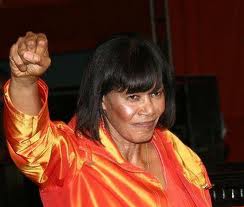
Prime Minister Portia Simpson-Miller

The fact that the People’s National Party was given a "bucket to carry water" (when on the 28th of December 2011, they swept to victory at the polls) wasn't much of a secret. The truth is, there was never any real doubt in our minds, that amidst all the prophecies that a vote for Mamma would guarantee ox tail instead of chicken back for Sunday dinner, as one die-hard Comrade convincingly declared in a television interview; those of us who had one ear to the  ground and one eye on the facts very much knew that we were indeed gearing up for challenging times.

Whether in the sweet jubilation of victory or the bitter sorrow of defeat, depending on if orange or green blood runs through his veins; John Public more than likely missed when the incoming Prime Minister herself admitted this by saying there was no honeymoon period ahead for her administration. Her poetic inaugural address littered with the usual signature Portia-style of twice as much fluff than substance went on to note that “In the Global Trade Winds of change, we are not always at liberty to direct these winds but we must set our sails to pilot the good ship Jamaica through these turbulent economic waters to safe harbour.”

A statement like that would give the most doubting of Thomas's the distinct impression that this new administration meant business and was ready, able and poised to take charge of the country's affairs. Albeit, no one genuinely believes all campaign promises, however, we do expect them to come with some amount of sincere possibility, for want of a better coined term.  Country people would say “if it nuh guh suh it near guh suh”.   In keeping with tradition, at the height of the campaign, Team PNP in true form made a host of promises to a host of people, and whiles one is quite aware that twelve months from five years is a merely the tip of the iceberg, it cannot be overlooked that there were many things that we were definitively told would be resolved before the dawning of 2013.  Needless to say, none of these have been forthcoming.


The PNP in its 2011 manifesto entitled ‘Leading the Agenda for Progressive Change’ chastised the previous administration for not signing a deal with the International Monetary Fund. It was evident by October that the IMF deal would not be signed by year end even though Dr. Phillips insisted that it was possible.  What is even more concerning is the seemingly lack of a plan post an IMF deal. The US $400million that we will receive cannot solve the problem. Our major challenge is our balance of payment which is our monetary transaction with the world.  We are spending a lot more on imports than we spend on exports and this creates a huge trade deficit.  We must solve our energy crisis and eat more of what we produce hence reducing our food cost.


The Jamaica Emergency Employment Programme (JEEP) was a major election promise and after much confusion it was finally launched. However, we are yet to see any results highlighting the major impact of this Emergency Employment Programme.  We have however seen a dip in the unemployment rate from 14 per cent to 12.8 per cent.  This credit can arguably be given to JEEP, however there is no sustainability as JEEP does not provide permanent employment. This reduction in unemployment can easily halt if there is no plan to keep the people employed. The government must get serious about job creation; we need jobs that will woo our graduates and reduce the number who leave and reduce the number who leave the country each year.  


The administration also promised the Jamaican people to remove GCT from electricity but instead the threshold was raised to 300kWh of electricity consumed, up from 200kWh.  Customers are now charged GCT on any consumption over 300 KWH. The tax moved from 10 to 16.5 per cent.  


The Net International Reserve (NIR) is currently below the international bench mark. In January 2011 the NIR was at US$1.961 billion and in December it stood at $1.078billion.  If we should have a crisis we have little money to buy
supplies. The international standard stipulates that we should have enough money to buy 12 weeks of imports. Just before Christmas we were at a value equivalent to 11.5weeks of imports.  The dollar also lost 7.4 percent of its value moving from $86 in January to $93.1 in December.


Cabinet of Jamaica


Many of the ministers who are a part of the Simpson-Miller 20 member cabinet have been dismal while a few seems like they are trying. Minister of Technology Phillip Paulwell hit the ground running; we got some encouraging signs when the Telecommunications (Amendment) Act 2012 was passed.  We have already seen some positive spin offs with LIME reducing its rates and forcing Digicel to follow suit. However, there are concerns that the minister has been too quiet for the last quarter of the calendar year.  He promised to implement the number portability policy of which the country should get an update on this issue. Much was expected from Robert Pickersgill Minister of Water, Land, Environment & Climate Change however very little was seen coming from that ministry.  Derrick Kellier who was Minister of Labour under the last PNP government was once again given the portfolio and his performance remains unsatisfactory.  It is time we have a strong labour minister who will fix some fundamental issues especially as it relates to the treatment of employees by their employers.  Peter Bunting the security minister has a seemly laid back approach however based on my political history almost every security minister from as far back as KD Knight have received a failing grade.  It therefore shows that the problem is beyond the minister and it will take collective support to lower crime.  The Minister however must be commended for significant gains made with the lottery scam.


Using the words of Prime Minister Portia Simpson Miller I think it is safe to say ‘time come’ for a cabinet reshuffle.  It is time for the government to get a jump start; we need to hear more from the Prime Minister.  This will give the Jamaican people the idea that she is in charge of the government and playing an active role.  To whom much is given much is expected and the People’s National Party must make some changes as they enter the second year as government.  The country is at a cross roads and we need strong leadership to steer this ship call Jamaica through the rough seas.

Saturday, 25 August 2012

Michael Manley's policies were ruinous


Friday, August 24, 2012

Dear Editor,
I find that too many Michael Manley loyalists struggle to articulate a convincing argument that - as Miss Tone Middleton said in her letter to the editor laced with invective - is the "most transformational and visionary leader Jamaica and the Caribbean have produced" and that "every major achievement by Jamaica since the 1970s can be directly or indirectly traced back to him."

How much more empty and pathetic can the rhetoric get? Michael Manley no doubt had a remarkable public personality, strong oratory skills and led a number of effective social reforms while raising consciousness, yet there is nothing else of substance worth mentioning. Former prime minister of Singapore, Lee Kuan Yew, a world-renowned example of a truly transformational and visionary leader, in his seminal book From Third World to First, in recalling a personal experience at a 1975 Commonwealth Summit in Kingston, stated, "(Michael Manley) presided with panache and spoke with great eloquence. But (I) found his views quixotic (impractical) ...; the policies of (his) government were ruinous." Now that's a quote for the ages.

Miss Middleton went on to state that I trotted out a "pile of meaningless statistics". Meaningless, Miss Middleton? Under Michael Manley's leadership between 1972 and 1980, the economy lost 17.5 per cent of its GDP; the national debt increased tenfold from $300 million to $3,000 million; inflation ballooned by 250 per cent; revenues remained constant while expenditure galloped by 66 per cent; the budget deficit sprinted from 3.9 per cent to 17.5 per cent of GDP, probably the highest for any country not at war; investment buckled by 40 per cent of GDP; foreign exchange reserves were eviscerated, collapsing from US$239 million to negative US$549 million; and unemployment increased by more than 43 per cent, moving from 182,000 to 271,000! The then World Bank president pointed out that Jamaica was the second worst economy in the world.

The fact is, Mr Manley oversaw the most comprehensive destruction of Jamaica's economy since Independence, damaging the future of my generation and the one before. Only PJ Patterson's economic management comes close.
Now, for Miss Middleton to credit the achievements of our sportsmen and sportswomen to Mr Manley is so silly, it deserves no further comment.
Former prime ministers, Bruce Golding, Edward Seaga, Hugh Shearer, Donald Sangster and Sir Alexander Bustamante deserve far more credit than the failed populist orator that Michael Manley was. Learn to argue with facts, Miss Middleton.

Delano Seiveright
delanoseiveright@yahoo.com


Monday, 4 June 2012

The PNP's Tax Package


L-R- Peter Phillips & Portia Simpson- Miller
Who would have thought that a little girl from Woodhall in St. Catherine would become Prime Minister of Jamaica, a common phrase used by the Most Honourable Portia Simpson-Miller, Prime Minister of Jamaica.  Mrs. Simpson Miller is known to speak for the poor and most vulnerable so it was a bit surprising that the first budget of her new administration would have hit the poor so hard.  Back in 2010 when the then Finance Minister Audley Shaw did a similar tax package, the then Opposition leader Portia Simpson threatened to lead island wide protests, she said ‘ I am ruling out nothing, all cards on the table’.  She called the package cruel, unjust and insensitive. Now isn’t it ironic that the very thing she chastised the then government about she is now doing?  Andrew Holness leader of the opposition in his budget presentation said that What has been presented is not stimulus but potential toxic shocks to remaining sectors of the economy that have been the lifeblood of our economic recovery, including tourism, telecommunications and business process outsourcing, agriculture and small businesses’  How can you bite the hands that feed you?  It is evident that no thought process went behind this budget and the administration tried to tap into any area in order to get much needed funds not thinking about the ripple effect.

Civil Society/ Sugar Divestment  
As a people there are certain principles that we must uphold regardless of who is in charge, however it seems like the goal post has shifted since the PNP took office.  In 2007 to December 2011 we had such active civil society groups; everybody had a comment to make about everything that was done by the Jamaica Labour Party. It is interesting that we are not hearing from these people and that the general reaction to this budget is so different from that of 2010.  I am also amazed that the very comrades who chastised the then administration are now finding excuses for this budget instituted by Dr. Phillips even though the PNP broke a solemn promise to the Jamaican people. It was Portia Simpson Miller while on the campaign trail in St. Thomas who said "My platform will promise nothing that we are not sure we can deliver" but it was her administration that did the direct opposite. The PNP promised to removed GCT on electricity which would give a break to the poor and the manufacturing sector instead they increased the GCT from 10 percent to 16.5 percent and the threshold to 300kw hours.  Prior to the reading of the budget it was Phillip Paulwell who said “There is a commitment that was given to the people of Jamaica which we intend to fulfil,” When quizzed about the promise, Peter Phillips responded by saying "A commitment was given in relation to GCT and by raising the threshold, we have in fact relieved all except the highest consumers of electricity."   This is such an insult to the intelligence of the Jamaican people and I am amazed that we sit and accept this explanation from the minister. We deserve to get an updates on the IMF deal; while in opposition the PNP, along with civil society would often ask the government to give updates to the people.  The previous administration had covered much needed ground on the issue of tax reform but since the PNP took office we have not heard anything further on this much needed reform. Civil society should be the one to chastise the administration from breaking its promise and to question them on issues of national importance, but instead they have rolled over and played dead. 

During the same week Agriculture Minister Roger Clarke during his sectoral presentation tried to create a smoke screen by disclosing the deal made between the JLP and the COMPLANT International Sugar Industry Company Limited. He told the house about the tax incentives received as part of an agreement to purchase government-owned sugar factories. This is a mechanism by the PNP to score cheap political points and to remove the attention from the tax package.  It is the norm for government to broker deals with investors.  The only other solution was to keep the sugar company on the budget and try to recover the money through taxation or to close the sugar factories and put thousands of people who are employed directly and indirectly out of a job.  The toll road investors have been given 40 years to control the toll income, this was an agreement inked that the PNP. They also negotiated the present contract with the Jamaica Public Service Company.  It is not unusual for successive administrations to broker certain deals which will encourage potential investors.  It is commendable that the JLP could have gotten such a deal in the middle of a recession.  It is time we stop playing politics and focus on investment which will help us as a people.

Solutions
My solutions to the gap in the budget are very simple; we need to cut the Jamaica Emergency Employment Programme (JEEP).  It is costing tax payers too much for work that can be done by the National Solid Waste Management Authority and the National Works Agency.  We need to focus on long term investment for our people, yes we all need jobs but at what cost?  It is pointless to have a quick fix to our problems and then raise taxes as the solution. 
It is also proposed that we revisit the issue of free healthcare.  Those who can pay must pay and while it is a tough decision to make it must be done.  We need to institute a health card system where the people of the country apply to the government.  An agency of the government should assess each applicant and then issue a card that will give them free healthcare at all government operated institutions. Of course there will be challenges at the start, but overtime we can enhance this system and save the government well needed funds.  The government must understand that taxation will not solve the problem, it will only force more people to find creative way to evade; investment will take us out of this crisis not taxation.

Tuesday, 1 May 2012

UWI: Institution of Higher Learning or an Intellectual Ghetto?


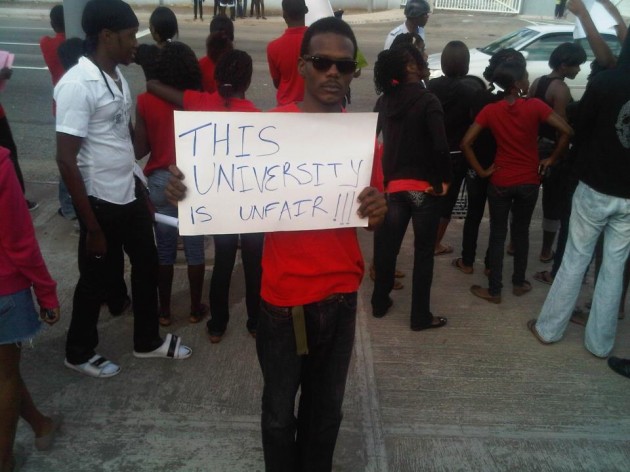
UWI Students Protest- April 30th, 2012

It is said that a mere twenty percent (20%) of the population have the opportunity to acquire a tertiary education, while there may be some variation, this percentage is relatively low.  It is for this reason why expectations are high and the level of decorum from these students should be commensurate with their level of education.    I recently read about the actions of some of the students of the University of the West Indies, and after seeing them on television I hung my head in shame.  These students disrupted an examination in progress, flung chairs to the ground and destroyed examination material all in an attempt for their voices to be heard.  The actions of these students led by the Guild were selfish; absolutely no consideration was given to the students who were adequately prepared for their examinations and paid their tuition in full. They are now forced to have their exams rescheduled.  It is time these students realize that the university must sustain itself. How can one expect to have good lecturers, air conditioner in classes, an efficient library among other things without paying their tuition?  According to UWI’s registrar the fees owed are in excess of $233 million dollars; this is a significant sum especially in a time when the university subvention from the government has reduced drastically and considering the changes on the financial front in light of recent recession.

It is also interesting to point out that the public only hear from the university students when tuitions are not paid.  Why should tax payers continue to fund the university when we get such unacceptable behaviour from our students who are supposedly the men and women that will lead our country forward?  The students who disrupted the exams should be arrested and face the courts. Why can’t I hear more about social programmes that these students participate in throughout the year, how are they through the university impacting the country positively?
Let me make it clear that students should pay their tuition in full before they are allowed to sit any exam; the university has implemented several mechanisms for students to create a payment plan.  We have to be forward thinkers and one cannot enter an institution of higher learning without any plans of how their tuition will be covered.  Every year, the university encourages students to pay fees; periodic reminders are issued and despite certain facilities established to help students many do not make use of this facility.  It must be made clear that I do not agree with the University to assign a failing grade for students who have not paid; instead an appropriate notification should be made to show that the student did not sit the exam.


UWI Students and Members of the Guild
It is time the university students elevate their thinking and I urge the members of the guild to find more appropriate ways of getting their point across to the administration. For the coming semester they should start a public education campaign to urge students to set up a payment plan for payment of tuition.  It is full time the guild begin to change its modus operandi. Demonstration of this nature only serves to disrupt progress.  Our future leaders must display a higher level of thinking and stop allowing people to call UWI an intellectual ghetto.


Thursday, 16 February 2012

Monarchy to Republic: The Saga Continues


As Queen Elizabeth II prepares to celebrate her Diamond Jubilee relevance of the monarchy to Britain's former colonies is being questioned. The most recent indication came from Prime Minister Portia Simpson-Miller who in her inaugural speech gave the clearest signal of the PNP lead administration’s plan is to move away from the monarchy. 

Most Hon. Portia Simpson- Miller, Prime Minister of Jamaica

She reiterated that as Jamaica celebrates its achievements as an independent nation we need to complete the circle of independence. "In this regard we will initiate the process of our detachment from the monarchy, to become a republic with our own indigenous president as head of state” said Mrs. Simpson-Miller.
Jamaica will not be the first to sever its links with the British monarchy to become a republic within the Commonwealth. In fact, Trinidad & Tobago who gained independence in 1962 severed ties with the British monarchy in 1976.   Guyana which gained independence in 1966 became a republic in February of 1970. The decision if taken, will effect changes to our legislative structure and I believe it should be done with the people in mind.
 
As head of State, Queen Elizabeth II is represented by a Governor General who is the vice regal.  Since the 1950’s the title of Governor General has been given to all representatives of sovereign independent Commonwealth realms, whose purpose is mere ceremonial. He acts upon the advice of the Prime Minister and in accordance with constitutional conventions.

Queen Elizabeth 11


If Jamaica, like Trinidad and Tobago transfers the role of Governor General to that of a president then I am not in support of this action.  What we would see is the office of president being mere ceremonial and in essence would perform the same functions that the Governor General is currently performing. 

We cannot move from the monarchy to an equally expensive ceremonial president. I am advocating for a worthwhile change and not just a change from Monarchy to Republic to say we are indigenous, that is not independence. What we should demand from our leaders is a complete overhaul of our structure of governance which is far reaching.  We cannot declare true independence if we do not have a system that is tailored for us, we must have a meaningful change. 

Suggestions surrounding this move should be focused on having a President who is directly elected by the people and who will serve the role of head of state and head of government.   The process of going republic is too complex for it to happen by year end; frankly the issue may even be shelved especially because members of the Royal Family will tour Commonwealth countries later this year and more specifically plans are already in full gear from Prince Harry visit to Jamaica.  

Saturday, 7 January 2012

A cabinet, breakfront or watnot? ... An analysis of the new cabinet


Less than twenty-four hours after taking the oath of office as Prime Minister of Jamaica for the second time, Portia Lucretia Simpson-Miller and her team of forty-two incoming members of parliament once again gathered at King's House, albeit on the inside this time for the naming and swearing-in of Jamaica's next cabinet which she will lead.

Although in much smaller numbers than the over ten thousand strong that littered the state lawns on Thursday, there was more than a buzz of excitement as prominent citizens, members of civil society, high ranking party supporters, the media and general well-wishers streamed into the ballroom way in advance of the slated 11:00a.m. commencement. At a quarter to the hour, journalists were already reporting that the ballroom, built to accommodate two hundred guests was full and overflowing and several people could be seen standing against the walls and even more on the outside leading into the foyer and onto the portico.

Then came 11:00a.m...then came 11:30a.m...then came 12 noon! And even though by then, Simpson-Miller and all those expected to be sworn-in were in their respective places for the greater part of an hour - there was no sign of the Governor General or any public announcement or apology from the powers that be as reasons for to hold up. Needless to say, restless guests were now evidently impatient as this delay was bound to cut deeper into their lunchtime than had been predicted.

Apparently operating from a different time zone, His Excellency Sir Patrick accompanied by Lady Allen sauntered in at what would now be a whopping 80-plus minutes late. After a brief a capella rendition of the national anthem, pitched most unceremoniously by...you guessed it - the GG himself, the programme got under way. Clearly something was wrong in the state of Denmark. But of course, nothing would put a damper on the swearing-in of Sista P's cabinet and for the next hour we would labouriously watch twenty-seven people come and go repeating as though a nursery rhyme, the oath of office as ministers and state ministers; before crossing the floor one by one to receive their obligatory trademark hug and kiss from a glowing comrade leader.

And.......Yes! You heard me right - Simpson-Miller included, there are twenty ministers and seven state ministers in the new cabinet. Only the second largest in our nation's history since Michael Manley's twenty-three ministers in 1976. Then, as if to add insult to injury, having been put through the painful ordeal of hearing the two part oath a record twenty-six times in one day, the specific portfolio responsibilities were not disclosed then and there and we would have to wait another lifetime for an official announcement much later in the evening.

So as to not hold you any more in suspense, here are the portfolios:

• Prime Minister and Minister of Defence  • Peter Phillips - Finance, Planning & the Public Service• AJ Nicholson - Foreign Affairs & Foreign Trade• Peter Bunting - National Security• Ronald Thwaites - Education• Lisa Hanna - Youth and Culture• Robert Pickersgill - Water, Land, Environment & Climate Change• Fenton Ferguson - Health• Anthony Hylton - Industry, Investment & Commerce• Mark Golding - Justice• Derrick Kellier - Labour and Social Security• Noel Arscott - Local Government & Community Development• Omar Davies - Transport, Works & Housing• Wykeham McNeil - Tourism & Entertainment• Phillip Paulwell - Mining, Energy & ICT• Roger Clarke - Agriculture & Fisheries Portia Simpson Miller, 
Ministers Without Portfolio

• Morais Guy - Transport, Works & Housing (Housing)• Sandrea Falconer - Office of the Prime Minister (Information)• Horace Dalley - Finance, Planning & Public Service (Public Service)• Natalie Neita-Headley - Office of the Prime Minister (Sports)
Ministers of State
• Arnaldo Brown - Foreign Affairs & Foreign Trade• Sharon Ffolkes Abrahams - Industry, Investment & Commerce• Ian Hayles - Agriculture & Fisheries• Colin Fagan - Local Government & Community Development• Richard Azan - Transport, Works & Housing• Damion Crawford - Tourism & Entertainment• Julian Robinson - Mining, Energy & ICT• Luther Buchanan - Office of the Prime Minister 
Now, let me be very clear, I do not have a problem with the size of the cabinet, but I do find it a bit ironic, amusing even, that this comes on the heels of the very same Simpson-Miller being highly critical of and almost scolding the former Bruce Golding led 18-member cabinet...  Styling it in dramatic fashion as - "a watnot". Well, Knock Knock Mrs. Simpson-Miller, just in case you haven't realized...what you have here is a pretty large break front! To be fair, one must call a spade a spade; and this spade could easily be considered a shovel!

There has been extensive research and reports done on cabinet size worldwide and I agree firmly with the school of thought that there should be no fixed numbers to a cabinet and Prime Ministers should be free to adjust, add, minus, multiply and divide as he or she so sees fit in keeping with the needs, the projections, the expectations and the budget of the day. However, what I cannot ever agree with is tokenism, and this cabinet seems to be heavily ladened with quite a few rewards to old faithfuls and young cousins of the comrade leader.


A minister with responsibility for nothing but sports? Sports could have easily been placed with Tourism or with Youth & Culture, as it has been in the past.

Then there is the return of the old titans - AJ Nicholson and Roger Clarke. One cannot help but think that certainly these two appointments must be a regression of sorts, as these men have served in cabinets from as far back as the eighties.


Mark Golding, while being a trained attorney has made a sterling career for himself as an investment banker and business leader, would he not have been better utilized in Industry and Commerce or better yet, in Finance?

Since Nicholson had to be rewarded for staying the course, why not give him Justice? A portfolio with which he is all too familiar.  Golding to Industry and Hylton, who has shadowed and acted as Foreign Affairs Minister for some time to that very ministry.
Youth, Sports and Culture was already a waste of public funds under the JLP administration, as Youth could have easily been paired with Education and Sports & Culture administered by Tourism. Now one must agree that Lisa Hanna is deserving of a ministry, but I cannot support the maintenance of this farce especially with the discipline of sports taken away.

Then, there are all of three ministers in Transport, Works and Housing - Dr. Omar Davies and Dr. Morais Guy as full ministers, the latter with specific responsibility for Housing and Richard Azan as state minister. By all indications, this is not a "super-ministry" in its true sense, so the question here is - couldn't a minister and a state minister alone have done the trick?

Finance, Planning and the Public Service whiles staffed with two fairly competent men - Dr. Peter Phillips (seen by many as the de facto Deputy Prime Minister) and former Health Minister Horace Dalley, seems to lack the real technical competence that would be needed at a crucial time in our nation like this. Maybe this is where an extra minister without portfolio should have been wasted.

Now to Simpson-Miller's Office...with just Sports under Natalie Neita Headley's belt and Information with Falconer, I am at a genuine loss as to why the Prime Minister's Office would have to be staffed with a state minister, in the person of Luther Buchanan.. Certainly, Neita-Headley will have so much time on her hands when Sports is "out-of-season", that whatever Buchanan is being brought there to do, she and Falconer could more than straddle between the two of them.

That aside, many of those expected to take particular portfolios were so appointed and there were not any major surprises with probably the exception of the total absence of former general secretary and Simpson-Miller loyalist - Collin Campbell.

While we may have our differences on this new cabinet it is important that these members perform and stand firm by the mandate they have been given.  The needs of this country are great and the people have placed a significant amount of trust in this administration.  While it is evident that some of the members of this cabinet were rewarded because of loyalty and long service we expect that they will prove the naysayers wrong.  I can only hope that they will perform above expectation, because in the end...PNP and JLP aside, the country will be the ultimate victor.

Wednesday, 4 January 2012

Jamaica- not just the Government's Business...the People's Business


It was the IMF head Christine Lagarde who said that "There is no economy in the world, whether low-income countries, emerging markets, middle-income countries or super-advanced economies that will be immune to the crisis that we see not only unfolding but escalating."  It is against the background of such a frightening statement that the Portia Simpson-Miller led People’s National Party will take the rein of governance in Jamaica.  The People’s National Party will face significant challenges with a debt running at approximately 130per cent of GDP and unemployment at 12per cent.  Despite this phenomenon the people of this country are expecting opportunities.  As such this government must be decisive; there will be no honeymoon period and the ministers must be skillful in managing their portfolio with little or no room for error.  The electorates are expecting maximum performance and will vote against a government if they believe that they are not doing enough to serve the interest of the people.  As such there are some key areas that this government must give serious attention.

Priority areas
 Attention must be given to the increasing oil bill, the cost continues to escalate and the ripple effects are felt all over the country.   This government must ensure that they find a cheaper alternative to oil whether it is Liquefied Natural Gas, coal or some other choice.  This alternative source must help to reduce production cost and thereby reduce the cost for several items in the country.  The PNP in its manifesto promises to re-engineer Petrojam through a joint venture partnership and they promise to re-formulate the Liquefied Natural Gas Project within the context of a competitive exercise where the market makes a determination as to the fuel sources.  For too long this issue of alternative source of energy is on the table and the longer the government takes to deal with this issue is the longer the country suffers.  It is imperative that this government seek comprehensive advice and make a decision (after consultation with industry players) in selecting an alternative source of energy.  Leaving it to the market to decide will take years as people will always present pros and cons to any energy alternate that is placed on the table. 

Attention must also be placed on job creation; many persons are desperate for employment opportunities to advance themselves. Jamaica Emergency Employment Program (JEEP), a major Job creation proposal of the PNP is not far reaching and the government must find innovative ways to get Jamaicans employed.  JEEP may provide a temporary solution for the people within the inner city but there are a large number of graduates that leave university who are jobless and as such a widespread solution must be provided.   Careful attention must be given to the micro and small business enterprise as they may be a key source in stimulating the economy.  The Information and Communication Technology (ICT) is an area that this government plans to examine and it may reap some level of success. We have seen a steady increase of call centres and there is potential for an expansion. 
The deal with the International Monetary Fund is also important and the PNP must close the deal in the shortest possible time.  Renegotiation is not an option as clearly outlined by the Fund but what could be suggested is that we have an Extended Fund Facility which will give us enough breathing room to deal with the issues of tax reform, public sector rationalization and pension reform. 

Good governance is one of the most important features of any governing body and the PNP cannot lose its connection with the people.  Mrs. Simpson- Miller in her victory speech said, "We will tell you as it is, we will hide nothing from you, when it is tough and rough we will let you know, when it is easy we will let you know." The government must always respect the people but must ensure that they explain the realities to them.  Honesty is always important and there is no room for corruption. Where there are incidences of corruption the leadership must ensure that they are decisive and just in its actions.

Areas of Interest in the PNP's Manifesto
 The PNP promises constitutional reform and this is important, we have seen significant development in this area under the JLP government and it must be continued by the PNP. The transformation of the police force to a civilian law enforcement organization is also under the microscope.  The government must position itself in such a way to change the way people view the police force and have the human rights as high priority. 

The PNP also proposes to develop a special unit that will deal with extreme violence, this is a key factor in developing as a nation and being that the crime rate is on a low it should be the government’s intention to keep this inversely proportional to the level of production.  There are plans to implement the Individual and Corporate Insolvency Act; this will replace the bankruptcy act and will give protection to businesses that have the potential to survive if given enough breathing room.   I am particularly interested with the proposed idea to establish Local Public Accounts Committees within the parish councils.  The government needs to ensure that its officials on all level are accountable to the people who elected them.  The renegotiation of the Jamaica Public Service contract if successful will reap significant benefits to the country.  This will create competition and give people the opportunity to make choices hence breaking the monopoly of the Jamaica Public Service.

The next three to five years will be challenging for both the government and the people who are about to encounter a different transition. The government must ensure that the ministers are effective and that the country is well aware of its every move. The opposition must ensure that they keep the government on its feet and the people of this country must be the ultimate watchman as the government moves forward on the mandate given to them by the people. The party leader needs to be assertive and responsive, cognizant of sensitive issues and she must also prove herself ready to lead a nation that is destined for greatness.